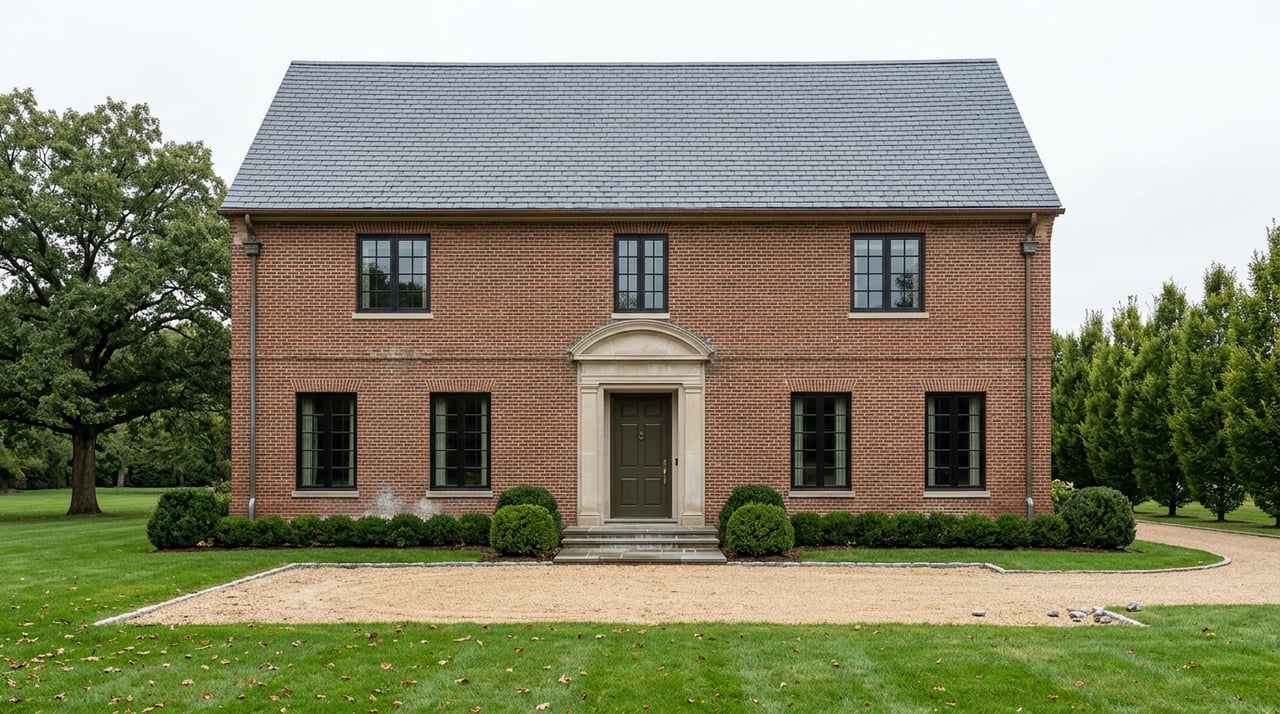
River Hills Has No Town Square. It Has a Sculpture Garden Instead.
September 24, 2026
September 24, 2026
Walk from the front gate at 2145 West Brown Deer Road on a September afternoon and the first thing you notice is what isn't there. No sign for a coffee shop. No parking meter. No strip of shops to duck into if it starts to rain. You are standing on grass that used to be a private estate, looking at a Henry Moore next to a stand of oak trees, and there is nowhere else in the village that looks quite like this because there is nowhere else in the village, period. River Hills does not have a downtown. It never built one on purpose.
That absence is not an accident of geography. It is the point of the place, and it is the reason a single piece of philanthropic real estate ended up carrying more public weight than anything the village government actually owns.
When River Hills incorporated in 1930, the families behind it were not trying to build a commercial district. They wrote zoning rules that required houses to sit on lots of at least one acre and banned commercial and industrial use outright, anywhere within the village boundary. River Hills remains the only community in Milwaukee County zoned one hundred percent residential, and roughly eighty five percent of its residential lots run over five acres. There was never a plan for a Main Street because the founding document made one illegal.
That decision shapes almost everything about how a resident's week actually works. There is no business to walk to. There is no municipal building doubling as a community hub in the way it does in a village with a commercial core. The public life that most suburbs organize around a downtown had to go somewhere else in River Hills, and it went to two institutions that the village does not own at all.
The Lynden Sculpture Garden sits on the site of what was, until 2010, simply someone's backyard. Harry and Peg Bradley bought the flat farmland north of Milwaukee in the late 1920s and hired Chicago landscape architects to turn it into an English country park, complete with a lake and a rustic bridge built to remind Harry of the swimming hole he knew as a boy in Kansas City. Starting in 1962, Peg began collecting monumental outdoor sculpture, and by 1978 she had assembled a collection that now includes work by Henry Moore, Isamu Noguchi, Barbara Hepworth, Alexander Liberman, and Mark di Suvero, spread across forty acres of park, lake, and woodland.
The Bradley family opened the grounds to the public in May 2010. Admission is free, a decision the organization credits directly to its donors rather than to any village funding. River Hills residents get something the general public does not: a membership underwritten by the River Hills Foundation, with support from residents of the village itself, so the closest thing the village has to a civic building is not paid for by taxes at all. It is paid for by the same neighbors who use it.
That distinction matters more than it sounds like it should. In a town with a real downtown, the library or the rec center belongs to everyone by default. In River Hills, the equivalent belongs to everyone because a private foundation decided it should, and because the family that built the place chose to give it away rather than keep it behind a gate.
The current gallery exhibition on view is Warren King's Homecoming, and Lynden is also hosting Bonsai at Lynden, offered in partnership with the Milwaukee Bonsai Society. Neither requires an appointment. You check in at the front desk in the main house, grab a paper map, and walk the grounds on your own schedule, though the organization is upfront that there are no paved paths and suitable footwear is not optional advice.
The fall calendar has one addition worth circling. Lynden is partnering with Milwaukee Chamber Theatre for a preview event tied to the world premiere of Maybe We'll Fly, a new play by Marie Kohler with music by Josh Schmidt, directed by Elizabeth Margolius, opening MCT's 2026/27 season. The play draws on the life and legacy of artist Mary Nohl, and Lynden has a direct connection to that legacy: the organization administers the Mary L. Nohl Fellowship for Individual Visual Artists, funded through Nohl's bequest to the Greater Milwaukee Foundation. The preview event runs before the performance itself, with check-in, designer displays, and food starting at 6 p.m. and the program beginning at 6:30, giving attendees time to walk the grounds and see the current exhibition first.
None of this required a village budget line. It required a nonprofit board, a theater company willing to partner, and forty acres that happen to sit inside village limits.
Milwaukee Country Club tells a parallel story, with one important difference. The club moved to its present site on the western bank of the Milwaukee River in 1911, and its Colt and Alison-designed course, which opened in 1929, still runs along a stretch of river valley that one Golf Digest panelist summed up simply as "a unique treat." The club has kept up with the course rather than freezing it in amber. Consulting architect Tom Doak and his associate Don Placek recently removed trees along several of the upland holes specifically to reopen the sightlines to the river below, and the work has paid off in the rankings: Golf Digest's 2025-'26 cycle has Milwaukee Country Club at 4th in Wisconsin, part of a top five streak the course has held since 1989.
Here is the difference that matters for anyone living in the village rather than visiting it. Lynden is free and open to the public. Milwaukee Country Club is neither. It is private, membership-based, and closed to the general resident who has not joined. Two of the most significant pieces of land in River Hills carry real cultural and recreational weight, and only one of them belongs to the village in any meaningful sense, even informally. The other belongs to its members, full stop.
What the village government actually runs is much smaller in scale, and that scale is the tell. River Hills holds two Village Clean-Up Days a year, one in spring and one in fall, each running a tidy three hours on a Saturday morning. This fall's date is October 17, 9 a.m. to noon. That is close to the extent of the village's own organized civic calendar. There is no farmers market to schedule, no street festival to close roads for, because there is no street of businesses to festival around.
Ask residents what they actually do with their time here and the answer tracks the zoning rather than any events calendar. Local activity around River Hills skews heavily toward gardening and landscape work, walking, hiking on trails, dogs, and home improvement, the kind of pursuits that need acreage rather than storefronts. People here describe the village in terms of quiet, walkability, and wildlife, not in terms of where to grab dinner, because there isn't a where.
Put those pieces together and a shape emerges that a typical suburb doesn't share. River Hills wrote its own commercial district out of existence in 1930 and never looked back. Ninety six years later, the village's only truly public gathering space, free and open to anyone, is a piece of land a wealthy family chose to give away rather than something the village itself built or funds. Its most storied recreational institution belongs to members only. And the village's own contribution to the community calendar amounts to two mornings a year with trash bags and volunteer gloves.
That is not a complaint. For a place that never wanted a downtown, it is a remarkably functional workaround, and it is why the Lynden Sculpture Garden matters to River Hills in a way that goes beyond having a nice place to walk. It is doing a job the zoning code made sure no business ever could.
If you already know this rhythm because you already live it, this fall's calendar at Lynden is worth putting on your own. And if you are weighing what any of this means for your own address in River Hills, whether it is time to sell, to understand what your property is actually worth in the current market, or simply to talk through what ownership here looks like long term, Brynn Woll knows this village from the inside and is glad to schedule a call or run an instant home valuation whenever you're ready.
Stay up to date on the latest real estate trends.

Brynn is committed to providing personalized and comprehensive real estate services, ensuring a seamless and successful experience for every client.
BRYNN WOLL
W63N706 WASHINGTON AVE CEDARBURG WI 53012